

Maintaining a thriving garden, lush lawn, or high-yielding vegetable plot requires a delicate balance of soil nutrients, sunlight, and precise hydration. For decades, home gardeners and commercial landscapers relied on manual hose drag setups or rigid mechanical dial timers. These legacy methods often resulted in either shallow root growth from under-watering or costly utility bills and root rot from severe over-watering.
Selecting one of the 10 best outdoor irrigation timers controllers for precise garden watering turns tedious manual hose handling into a seamless, automated process in 2026. Modern smart controllers adjust runtimes based on hyper-local satellite weather feeds, monitor real-time soil moisture levels, and allow remote management through intuitive smartphone apps.
Whether managing a compact backyard vegetable plot, delicate flower borders, or multi-zone agricultural turf, installing a controller reduces water consumption by up to 50%. Advanced evapotranspiration (ET) algorithms calculate exact solar radiation, relative humidity, wind velocity, and ambient temperatures to determine the exact fluid dynamics required for every plant bed. To explore top discounts on modern garden equipment and household utility tools, visit Promsdeal.
The Evolution of Outdoor Garden Irrigation Management
The history of agricultural and residential water management has undergone a massive transformation over the past three decades. Early mechanical clock timers operated on physical pin-and-gear mechanisms that fired solenoids regardless of whether a torrential rainstorm was occurring outside.
As digital microchips became cheaper, digital timers introduced rudimentary daily interval scheduling. However, the true revolution occurred with the integration of Internet of Things (IoT) hardware, real-time weather API integration, and cloud-assisted analytics.
Modern smart irrigation controllers do not merely react to set schedules; they dynamically calculate water budgets based on real-time climate data. By understanding local evapotranspiration rates, soil percolation speeds, and root-zone depth, these systems eliminate human error, ensuring your landscape receives exact hydration while conserving local water supplies.
Key Features of 10 Best Outdoor Irrigation Timers Controllers for Precise Garden Watering
Evaluating core technical specifications guarantees your chosen device meets the specific hydration demands of your landscape layout. Before investing in an irrigation unit, gardeners should evaluate several pivotal parameters:
1. Zone Capacity & Circuit Mapping
Zone capacity dictates how many individual solenoid valve circuits a single controller can manage independently. Varied plant species require radically different watering intervals:
- Turf Grass: Requires deep, infrequent watering cycles to encourage deep root anchor points.
- Raised Vegetable Beds: Needs frequent, shallow moisture drip applications to prevent fruit splitting.
- Drought-Tolerant Shrubs: Demands minimal water volume delivered on long cycle delays.
Selecting a controller with multi-zone capabilities allows custom programming across separate channels, guaranteeing zero water waste.
2. Smart Sensor Integration & Local Telemetry
Integrating external physical sensors transforms a static timer into a responsive environmental safeguard. High-end systems feature direct input terminals for:
- Rain Shutoff Probes: Disables scheduled runs when rain gauge cups catch a pre-set threshold of precipitation.
- Soil Moisture Sensors: Measures Volumetric Water Content (VWC) directly at the root level, skipping irrigation when deep soil layers remain damp.
- Freeze Sensors: Prevents line freezes and plant shock by locking out water valves when ambient air drops below freezing.
3. Mobile App & Cloud Ecosystem Sync
Modern connectivity standards—including 2.4 GHz/5 GHz dual-band Wi-Fi, Bluetooth 5.0, and cloud dashboards—allow remote system management from anywhere in the world. Push notification systems alert homeowners instantly to wiring faults, low valve voltage, or sudden line breaks.
4. Power Architecture & Battery Backup Resilience
Outdoor hardware must operate continuously regardless of local utility disturbances. Top controllers utilize triple-redundant power designs:
- Primary Transformer: Converts residential AC line current (110V/220V) down to stable 24VAC valve firing power.
- Non-Volatile Flash Memory: Saves watering programs safely during extended power outages.
- Rechargeable Backup Batteries or Solar Modules: Maintains internal real-time clock tracking and drives single-zone hose latching valves without shore power.
5. Weatherproof Housing & Enclosure Durability
Exposure to harsh UV rays, extreme summer heatwaves, ambient moisture, and winter frosts can degrade cheap plastic components. Look for controllers housed in high-impact polycarbonate cabinets rated IP65 or higher.
| Feature | Core Advantage | Why It Matters for 2026 Gardens |
| Zone Capacity | Targeted Hydration | Prevents over-watering drought-tolerant beds while keeping lawns green. |
| Weather Integration | Real-Time Adaptation | Automatically delays schedules when rain or freezing temperatures hit. |
| App Control | Anywhere Access | Adjust run times instantly from your phone while traveling. |
| Rugged Housing | Hardware Longevity | Resists UV degradation and water ingress over multiple seasons. |
Installation & Setup Simplicity
Modern controllers eliminate complicated technical steps during setup. Clear terminal markings, tool-free wiring strips, and intuitive mobile app pairing allow straightforward DIY installation.
- Color-Coded Terminals: Labeled ports ensure fast solenoid wire connections without electrical guessing.
- Guided App Wizards: Interactive menus lead users through Wi-Fi connection and initial schedule creation step by step.
- One-Touch Manual Run: Physical or digital override buttons allow instant manual cycles for spot checks or soil soaking.
- Plug-and-Play Sensor Sync: Automatic port recognition configures external rain and soil probes cleanly.
In-Depth Review of 10 Best Outdoor Irrigation Timers Controllers for Precise Garden Watering
1. Orbit B-hyve Smart Hose Faucet Timer
Orbit B-hyve Smart Hose Faucet Timer
- Connection: Hose Bib (1 Zone)
- Connectivity: Wi-Fi / Bluetooth
- Rating: IP65 Waterproof Enclosure
The Orbit B-hyve Hose Timer connects directly to standard outdoor hose spigots, bringing full smart home automation to hose-based watering systems. Equipped with an onboard brass inlet thread and high-pressure solenoid valve, it withstands city water pressure fluctuations easily.
Integrated Wi-Fi syncs with local hyper-local weather services to skip watering cycles automatically when rain is predicted, making it a clear pick among the 10 best outdoor irrigation timers controllers for precise garden watering.
- Core Features: WeatherSense® automated adjustments, manual override button on device, built-in flow meter telemetry.
- Pros: Highly affordable, quick tool-free setup, robust brass connection fittings.
- Cons: Single zone output per tap unit.
- Best For: Raised beds, patio garden containers, and single-zone hose setups.
- Explore updated product availability via Helium10 Product Details.
2. RainMachine Touch HD-12
RainMachine Touch HD-12
- Connection: 12 Hardwired Valve Terminals
- Display: 6.5″ Color Capacitive Touchscreen
- Data Source: Open Weather Data (No Subscription Fees)
The RainMachine Touch HD-12 features a vibrant 6.5-inch color capacitive touchscreen interface housed in a sleek indoor/sheltered outdoor enclosure. Managing up to 12 distinct irrigation zones, it retrieves environmental forecast data from NOAA, MetNo, and local personal weather stations (PWS).
Unlike closed cloud systems, RainMachine stores all watering algorithms and schedules locally on its board. If your home internet goes down, your garden watering schedule continues without interruption.
- Core Features: Local weather forecast processing, open API integration, touchscreen operation, offline memory execution.
- Pros: Zero monthly subscription fees, independent offline operation, high zone capacity.
- Cons: Requires sheltered mounting cabinet for harsh outdoor exposures.
- Best For: Medium-to-large residential landscapes with diverse planting zones.
3. Hunter Pro-HC Wi-Fi Irrigation Controller
Hunter Pro-HC Wi-Fi Irrigation Controller
- Capacity: 6, 12, 18, or 24 Fixed Zones
- Enclosure: Heavy-Duty Outdoor Lockable Wall Mount
- Platform: Hydrawise ® Professional Cloud Software
Engineered for demanding landscapes and professional groundskeeping, the Hunter Pro-HC scales effortlessly from 6 up to 24 zones. Encased in a heavy-duty, lockable, UV-resistant outdoor cabinet, it protects critical electrical components against weather and vandalism.
It integrates with Hydrawise® cloud software, continuously monitoring line currents to detect broken solenoids, faulty wiring, or plumbing leaks when paired with optional flow meters.
- Core Features: Hydrawise predictive watering, wiring fault alerts, flow meter tracking, dedicated master valve outputs.
- Pros: Enterprise-grade build quality, high zone scalability, flow-sensor leak detection.
- Cons: Premium price point for commercial features.
- Best For: Large residential estates, commercial landscapes, and multi-bed gardens.
4. Netro Sprite Smart Water Controller
Netro Sprite Smart Water Controller
- Capacity: 6 or 12 Zone Configurations
- Engine: Dynamic AI Cloud Engine
- Environmental Compliance: EPA WaterSense Certified
The Netro Sprite leverages advanced cloud AI algorithms alongside local weather telemetry and soil sensors to craft dynamic watering schedules. By evaluating specific plant species, soil texture, slope inclination, and historical sun exposure, it creates optimized runtimes that eliminate runoff.
It adjusts schedules dynamically to comply with local municipal drought restrictions, making it an ideal choice among the 10 best outdoor irrigation timers controllers for precise garden watering.
- Core Features: AI-driven schedule generation, local water restriction compliance, solar radiation modeling.
- Pros: Highly accurate AI schedule generation, sleek wall mount profile, EPA WaterSense certified savings.
- Cons: Highly reliant on stable 2.4 GHz Wi-Fi connectivity.
- Best For: Eco-conscious gardeners seeking automated AI water management.
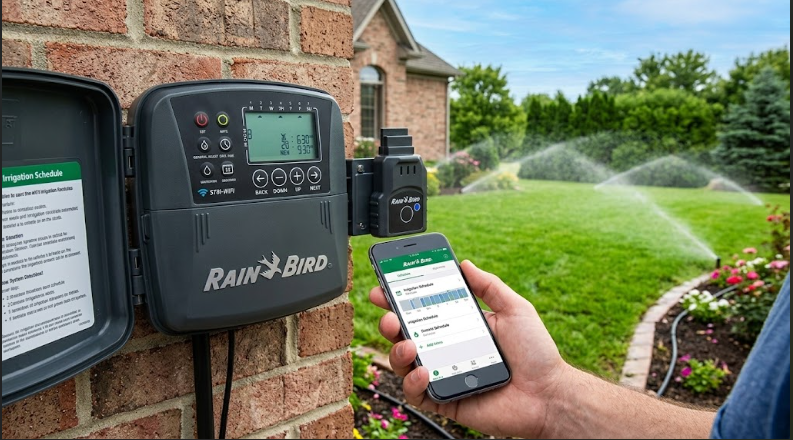
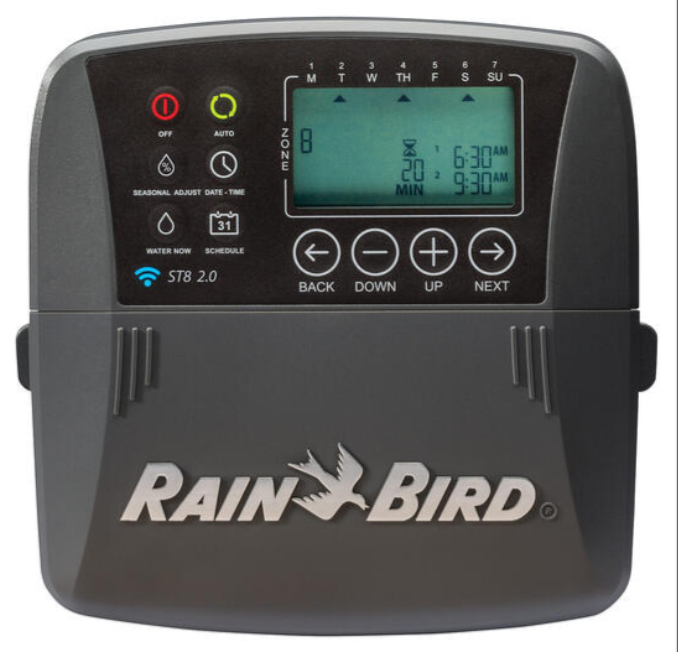
5. Rain Bird ST8I-WIFI Smart Irrigation Timer
Rain Bird’s 8-zone residential controller combines decades of proven commercial valve control with modern mobile connectivity. Built with robust surge protection circuits, it shields internal microprocessors against localized lightning spikes and voltage fluctuations.
Its proprietary Evapotranspiration (ET) algorithms adjust water delivery based on ambient solar intensity, humidity levels, and wind speeds, securing its position as a trusted standard for residential landscapes.
- Core Features: Custom zone naming, custom seasonal adjustments, surge-protected terminal board, ET auto-budgeting.
- Pros: Highly reliable valve switching, trusted commercial brand heritage, intuitive mobile interface.
- Cons: Wi-Fi module setup requires step-by-step app configuration.
- Best For: Traditional sprinkler systems upgrading to smart Wi-Fi controls.
Wyze brings budget-friendly multi-zone smart automation to home irrigation. Featuring a modular, sleek controller body, it connects to standard 24VAC solenoid valves while providing precise individual zone controls through the Wyze app.
Hyper-local weather sync pauses scheduled cycles when high winds, freezing temperatures, or heavy rainfall hit your area, preventing soil erosion and water waste.
- Core Features: Zone-by-zone custom schedules, real-time weather delays, smart app ecosystem integration.
- Pros: Exceptional value for money, simple modern mobile app, quick magnetic backplate mounting.
- Cons: Plastic enclosure requires an additional weather box for unprotected outdoor mounting.
- Best For: Budget-conscious homeowners building out smart home systems.
7. Gardena Smart System Control Center
Gardena offers a comprehensive European-engineered ecosystem that coordinates automatic valves, subsurface soil moisture sensors, and garden supply pumps into a unified wireless network.
Operating on a dedicated long-range radio frequency, the system maintains strong connections across large properties where standard Wi-Fi signals drop out. The wireless Gardena Soil Sensor measures subsurface root temperature and moisture levels, pausing cycles when soil conditions are optimal.
- Core Features: Long-range wireless gateway link, integrated pump control relays, real-time root telemetry.
- Pros: Unmatched range performance, seamlessly integrated soil sensor ecosystem, heavy-duty build quality.
- Cons: Ecosystem lock-in requires Gardena Gateway hardware.
- Best For: Large properties, extensive gardens, and integrated irrigation setups.
8. Toro Evolution Smart Wi-Fi Controller
Toro’s Evolution series combines commercial-grade durability with flexible modular expansion. Starting at 4 zones, users can expand capacity up to 16 zones using simple drop-in terminal modules.
Its dual-input sensor terminal board connects directly to physical rain and soil moisture probes simultaneously. Non-volatile internal flash memory retains all schedules through seasonal power outages, ensuring consistent performance among the 10 best outdoor irrigation timers controllers for precise garden watering.
- Core Features: Modular zone expansion slots, historical usage logging, dual sensor inputs, smart wireless handheld remote support.
- Pros: Easily expandable, simple physical keypad controls, rugged weather enclosure.
- Cons: Larger cabinet size compared to compact smart timers.
- Best For: Growing landscapes that require future zone additions over time.
9. Rachio 3 Smart Sprinkler Controller
The Rachio 3 stands as a gold standard in smart irrigation management. Powered by Weather Intelligence™ Plus technology, it analyzes radar, satellite data, and thousands of local weather stations to calculate hyper-local precipitation forecasts.
It offers custom soil profiling—allowing users to enter soil types (clay, loam, sand), slope incline, plant varieties, and sun exposure levels per zone to calculate exact absorption and cycle-soak intervals.
- Core Features: Weather Intelligence™ Plus, cycle-and-soak technology, broad smart home platform integration (Amazon Alexa, Google Assistant, Apple HomeKit).
- Pros: Highly accurate weather integration, intuitive app design, simple tool-free wire terminals.
- Cons: Outdoor wall mounting requires purchasing the weather enclosure case separately.
- Best For: Complete hands-free automated water management.
- Check current pricing and deals through Helium10 Deals.
10. Orbit B-Hyve XR Smart Controller
The Orbit B-Hyve XR features an upgraded IPX5 weatherproof enclosure with a sleek digital interface display. Built for direct outdoor mounting, it houses internal transformers and wire terminals safely behind a lockable front cover.
Dual long-range radios ensure reliable connections even when installed on outer garage walls or remote pump sheds, cementing its place among the 10 best outdoor irrigation timers controllers for precise garden watering.
- Core Features: WeatherSense® technology, long-range Bluetooth & dual-band Wi-Fi, clear illuminated front display.
- Pros: Built-in weatherproof outdoor housing, excellent wireless range, simple physical manual control options.
- Cons: Slightly larger wall footprint.
- Best For: Direct outdoor installation in harsh environments without extra enclosures.
Technical Comparison Matrix
| Model Name | Zone Capacity | Wireless Link | Power Source | Standout Feature |
| Orbit B-hyve Hose | 1 Hose Port | Wi-Fi / Bluetooth | 2x AA Batteries | Direct hose tap simplicity |
| RainMachine HD-12 | 12 Zones | Wi-Fi | 24VAC Adapter | Local touchscreen display |
| Hunter Pro-HC | 6 – 24 Zones | Wi-Fi / Cloud | 24VAC Hardwired | Flow-meter leak detection |
| Netro Sprite | 6 or 12 Zones | Wi-Fi | 24VAC Adapter | AI-driven soil profiling |
| Rain Bird ST8I | 8 Zones | Wi-Fi | 24VAC Adapter | Proprietary ET adjustments |
| Wyze Valve | Up to 8 Zones | Wi-Fi | 24VAC Adapter | Budget-friendly modular design |
| Gardena Smart | 6 Zones | 868 MHz Gateway | 24VAC / Solar | Long-range radio link |
| Toro Evolution | 4 – 16 Zones | Wi-Fi | 24VAC Hardwired | Modular expansion slots |
| Rachio 3 | 4 – 16 Zones | Wi-Fi (Dual-Band) | 24VAC Adapter | Weather Intelligence™ Plus |
| Orbit B-Hyve XR | 8 or 16 Zones | Wi-Fi / Bluetooth | Integrated 24VAC | IPX5 outdoor-rated case |
Agronomic Principles of Precise Garden Watering
To maximize the performance of your smart controller, it helps to understand basic agronomic principles regarding how water moves through soil and roots.
(Temporary excess, drains downward)
(Optimal soil air/water mix for roots)
(Soil too dry, plant distress)
Volumetric Soil Water Content & Field Capacity
Soil acts like a sponge, retaining water within tiny pores between dirt particles.
- Saturation Point: Occurs when all soil pores are filled with water, forcing out vital oxygen. Prolonged saturation causes root rot and anaerobic fungal blooms.
- Field Capacity: The optimal moisture level remaining in soil after excess water drains away due to gravity. This represents the ideal state for plant root uptake.
- Wilting Point: Occurs when soil moisture drops so low that plants can no longer extract water molecules, leading to cell collapse and wilting.
Smart controllers manage watering intervals to keep soil moisture levels consistently between Field Capacity and the Allowable Depletion Limit, preventing plant stress and eliminating runoff.
Advanced Hydraulic Management & System Design
Beyond selecting a high-quality controller, maintaining proper hydraulic management ensures equal water distribution across every line.
Water Pressure Regulation
Excessive municipal water pressure (above 50 PSI) can cause drip lines to blow off fittings or turn sprinkler sprays into fine mist that evaporates before reaching the ground.
Installing pressure regulators downstream of valve outputs keeps pressure at ideal operating levels:
- Drip Irrigation Lines: Requires 15–25 PSI.
- Spray Head Sprinklers: Requires 30–45 PSI.
- Rotor Sprinklers: Requires 45–65 PSI.
Cycle-and-Soak Programming
When watering heavy clay soils or sloped landscapes, water is often applied faster than the ground can absorb it, leading to runoff onto sidewalks and driveways.
Cycle-and-Soak splits total watering runtimes into shorter cycles separated by absorption pauses:
This technique ensures deep root hydration without surface runoff or soil erosion.
Seasonal Troubleshooting & System Maintenance
Regular seasonal maintenance ensures your irrigation system operates smoothly year after year.
Spring Startup Protocol
- Inspect Enclosure Seals: Check rubber cabinet gaskets for cracks or dirt accumulation that could compromise weather seals.
- Flush Water Mainlines: Open manual drain valves and end caps to flush out accumulated sediment before attaching delicate drip emitters.
- Swap Backup Batteries: Replace backup AA or 9V batteries annually to keep internal clocks synchronized during power outages.
- Calibrate Sensors: Clean leaves, dust, and spiderwebs out of rain collector cups, and inspect wireless soil probes for damage.
Winterization Protocol
In regions subject to freezing winter temperatures, standing water inside valves, backflow preventers, and lines can freeze and rupture pipes.
Winterization Blow-Out Sequence
- Shut off main water supply valve.
- Connect air compressor (regulated to max 50 PSI) to blowout port.
- Manually open Zone 1 on controller; activate air flow.
- Blow out water until fine mist clears; cycle to next zone.
- Power down controller or activate “Standby/Winter Mode”.
Frequently Asked Questions
How do smart weather sensors save water in garden irrigation?
Smart controllers monitor hyper-local rainfall, solar radiation, relative humidity, and wind speed data in real time. When sufficient rain falls or humidity levels rise, the controller automatically pauses scheduled watering runs, lowering water bills by up to 30–50%.
Can I install an outdoor irrigation timer without hiring a professional technician?
Yes. Most modern 24VAC residential controllers and hose-faucet timers feature color-coded terminal strips and simple tool-free wire connectors, enabling simple DIY installation using standard household tools.
How many zones do I need for a standard home garden?
A standard residential property typically uses 4 to 8 zones. This allows separate, targeted watering schedules for front lawns, backyard turf, flower beds, and vegetable drip lines.
What is the difference between AC hardwired and battery-powered hose controllers?
AC hardwired controllers connect to standard 24VAC multi-zone solenoid valves using dedicated wiring cables. Battery-powered hose timers thread directly onto outdoor spigots to control a single hose line, making them ideal for small patio gardens or raised beds without nearby electrical outlets.
Will my smart controller keep watering if my Wi-Fi goes down?
Yes. High-quality smart irrigation controllers store all core programs and watering schedules directly in non-volatile flash memory on the device. If internet access drops out, the controller continues executing its last saved schedule until connectivity is restored.
Conclusion
Upgrading your setup with one of the 10 best outdoor irrigation timers controllers for precise garden watering brings consistency, convenience, and efficiency to your landscape routine. Whether utilizing simple single-zone hose timers or multi-zone smart hubs, automated watering conserves natural resources while ensuring healthy garden growth. For more home automation guides, gardening tips, and equipment deals, visit Promsdeal.
JSON-LD Schema Markup (Article & FAQ)